
Modified Tapioca Starch
Modified Tapioca Starch
Sub-category: Hydrocolloids & Functional Systems
Sub-category: Starches, Thickeners & Texturizers
Functional & Technical Characteristics
Tapioca-Based Source: Produced from cassava-derived starch and valued for its neutral taste and light colour.
Controlled Viscosity: Provides predictable thickening and consistent viscosity across production batches.
Process Tolerance: Selected grades can withstand high temperatures, shear forces, pressure, and challenging processing conditions.
Freeze–Thaw Stability: Helps reduce syneresis and maintain texture during freezing, storage, and thawing.
Acid Stability: Suitable grades retain functionality in acidic products such as sauces, fruit preparations, and dressings.
Water-Binding Capacity: Retains moisture and supports improved yield, softness, and product stability.
Texture Modification: Can provide smoothness, creaminess, body, elasticity, or firmness depending on the selected grade.
Film-Forming Ability: Certain grades can form protective coatings and improve surface appearance.
Neutral Sensory Profile: Delivers functionality with minimal impact on the finished product’s flavour and aroma.
Applications
Modified Tapioca Starch is widely used in formulations requiring reliable texture, stability, and process tolerance:
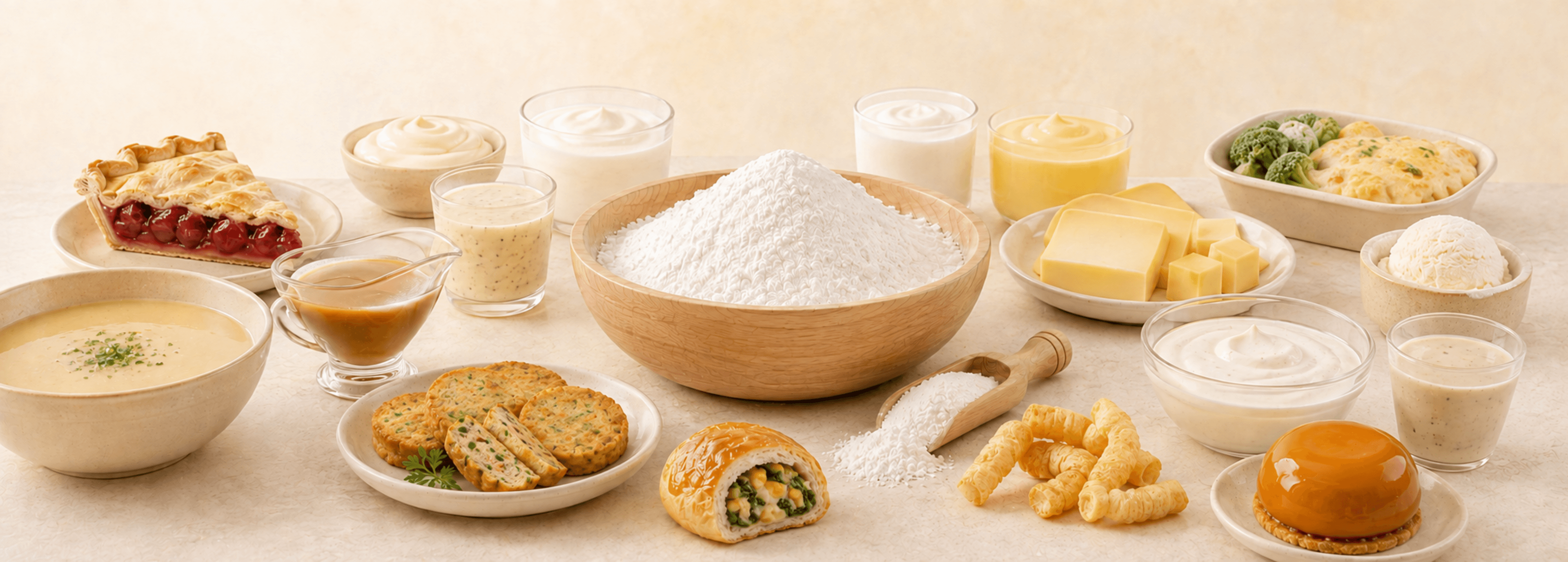
Soups, sauces, gravies, and ready meals
Salad dressings, mayonnaise, and emulsified products
Yogurt, dairy desserts, puddings, and processed cheese
Bakery fillings, creams, glazes, and pie fillings
Frozen foods, desserts, and ice cream
Noodles, pasta, snacks, and extruded products
Confectionery coatings and gummy systems
Plant-based dairy and meat-alternative products
Reduced-fat dressings, spreads, and sauces
Key Benefits in Formulation
Consistent Thickening: Creates controlled viscosity and a smooth, uniform mouthfeel.
Enhanced Product Stability: Helps prevent phase separation, water release, and texture deterioration.
Improved Processing Performance: Maintains functionality during heating, mixing, pumping, homogenization, and filling.
Better Freeze–Thaw Resistance: Reduces syneresis and protects texture in frozen and chilled products.
Moisture Retention: Supports softness, freshness, yield, and extended shelf-life performance.
Texture Optimization: Enables formulators to develop products ranging from creamy and pourable to firm and structured.
Fat-Replacement Potential: Adds body and creaminess to selected reduced-fat formulations.
Sensory Flexibility: Its neutral flavour and pale appearance allow use across diverse food categories.
Versatile Grade Selection: Different modification technologies can be matched to specific processing and finished-product requirements.
Quality & Sourcing Perspective
At Abhaya International LLP, Modified Tapioca Starch is selected with attention to botanical origin, modification type, viscosity profile, moisture content, particle characteristics, microbiological quality, heavy-metal limits, and batch-to-batch consistency.
The appropriate grade should be selected according to the formulation’s pH, processing temperature, shear exposure, hydration method, storage conditions, and desired finished-product texture. Supporting documentation—including specifications, certificates of analysis, allergen information, GMO status, and applicable regulatory declarations—should be reviewed for every supplied grade.
Pilot trials and finished-product stability testing are recommended to confirm dosage, processing behaviour, viscosity development, freeze–thaw performance, and shelf-life suitability before commercial production.


Contact Information
Our Offices
Let's Connect
Fill in your details and our team will get back to you.